
DOMESTIC FETISHES
KOOTENAY GALLERY OF ART
Castlegar, BC
August 28 - October 31, 2020
Grand Forks Art Gallery, Reid Gallery
Grand Forks, BC
January 31 - April 25, 2026






ARTIST STATEMENT
Domestic Fetishes
Domestic Fetishes are power objects relative to the world of an artist and woman who has done a heck of a lot of domestic work.
These are not the titillating fetishes of popular imagination but more akin to the original fetish, an inanimate object used for spiritual purposes. My fetishes are made with the female gaze in mind and carry funny-bone benefits. They invite collaboration with the viewer in making sense of everyday objects and materials.
Domestic work is the ghost in our economic machine. It mirrors a rationalist separation between body and mind – essential unacknowledged emotional labour that forms an invisible backbone to society. Childcare is but one example. Every day men, women, and children rappel the peaks and valleys of domestic mountains and molehills.
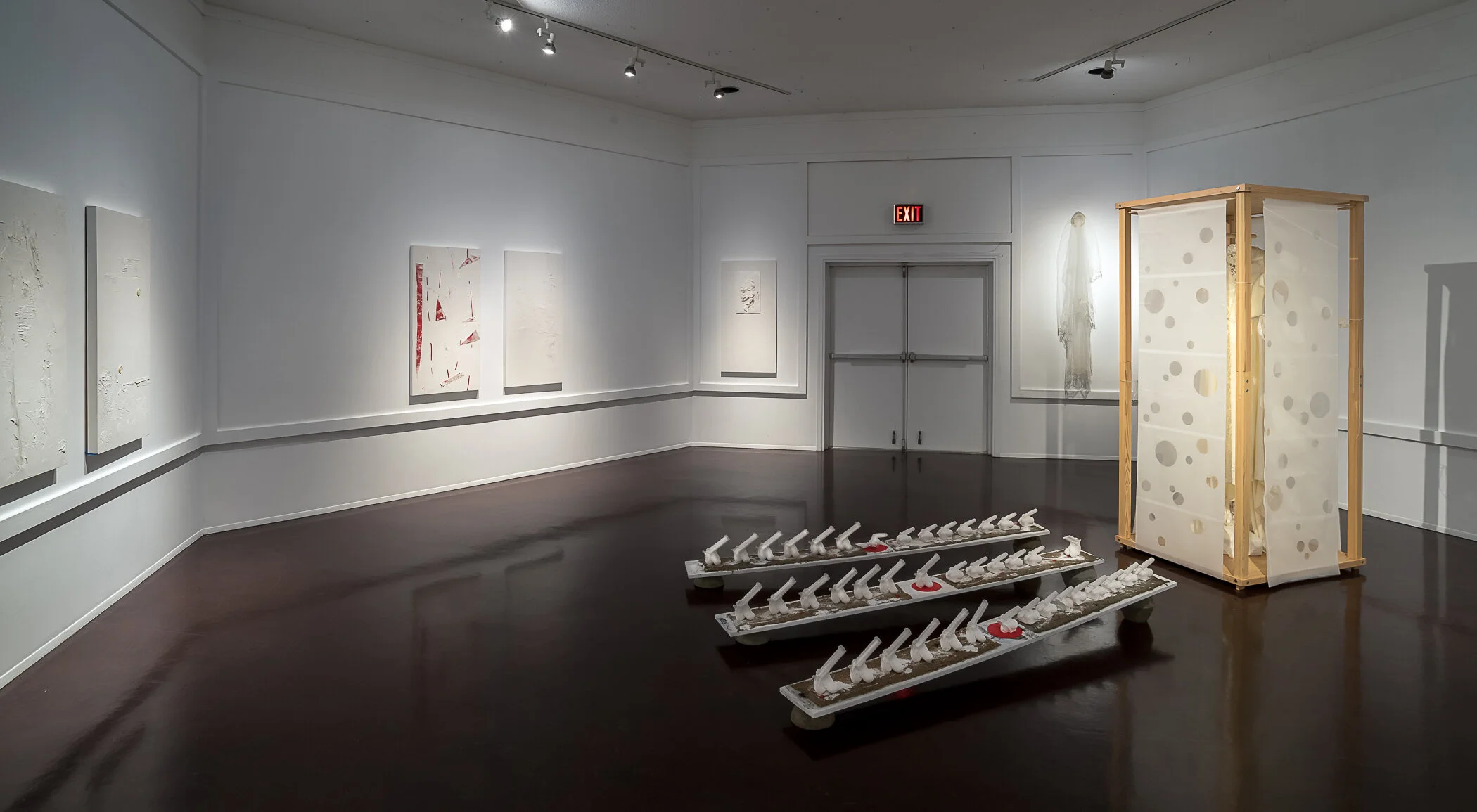
The installation of Domestic Fetishes means to represent the relative size of sperm (phalli) to egg (wedding dress) while deconstructing a few of the social mores surrounding conception and the resultant domestic realities.
Emptiness Broken by the State of Things — An Introduction to Domestic Fetishes
By Tracy Valcourt
In October 1966, Lucy Lippard organized Eccentric Abstraction at the Fischbach Gallery in New York, a show she claimed to have envisioned around the work of Eva Hesse and Frank Lincoln Viner, “a straight man who worked in fabric and did his own sewing.” (1) It is notable that Lippard should feel compelled to qualify Viner’s sexual orientation and to assert the fact that he did his own handiwork, a term which itself seems to trivialize the effort or knowledge required to make, repair or salvage — a lexicon veritably lost in the contemporary domestic space, which is now more centred around the concept of outsourcing.
Lippard’s comment is telling of the power of established gender norms to dictate relationships between bodies and objects related to the domestic; it hints as well at what kinds of bodies become domesticated, and require no qualification as such. It is this conversation that gets picked up again (if ever it were dropped) by Susan Andrews Grace in Domestic Fetishes, which is a timely dialogue with feminism’s past, present, and future that operates around objects and the orientations and roles that they have the potential to produce.
In Eccentric Abstraction Lippard sought a manner to “soften and broaden” minimalist concepts, through a kind of reconciliation of a contradictory aesthetic direction, which Hesse achieved via an almost osmotic relationship with materials that were given to imperfections or asserted a resistance to being completely controllable forms that were ordered but fundamentally unstable. Unlike the stricter materials of Minimalism, latex, vinyl, fiberglass were the media of choice of a group of artists like Hesse, who were working, according to Lippard,” in a curious place between biological and minimal abstraction; a space that was “later mostly claimed by women.”
__________
(1) Blanton Museum of Art. “Lucy Lippard Lecture.” YouTube video,
1:00:03. Aug 28, 2014 https://youtu.be/V50g8spJrp8.
-
Susan Andrews Grace is among the women claiming this space, claiming Her space; and insisting upon it in a world that is not particularly accommodating to the square footage of the feminine. Unlike certain of Hesse’s work, that of Andrews Grace is not made with resinous materials that operate around volatile chemical reactions (much like the body), but instead, she chooses plaster, clay, house paint, fabrics, discards, empty containers; chooses white; chooses the inert (or the semblance of); chooses things that unravel and fray. As such, while perhaps Hesse spoke of a resilience that would move inevitably towards deterioration, Andrews Grace talks about the innate precarity that exists within objects and arrangements superficially described as stable.
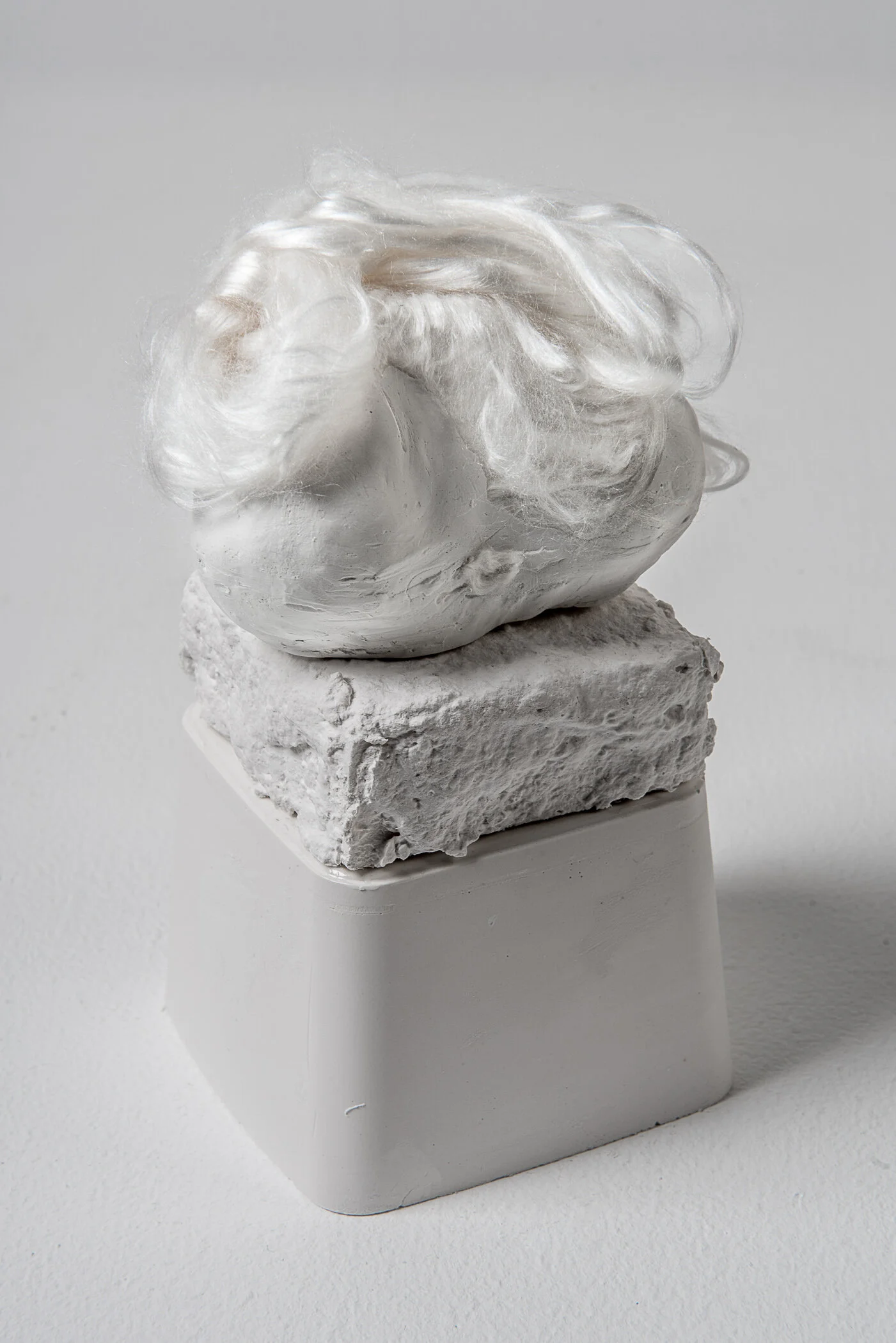
Take for example, “Kitchen Table with Pantry Ghosts,” (2020) a white slender-legged wooden table set for an untraditional feast that will never be attended. On it, cast plaster food containers are aligned on narrow burlap narrow belts, which seem to resist or reject their otherwise desired role as aesthetic runners or functional place mats. Some of the vessels hold pale strands of kibiso, which is the protective outer surface of silk cocoons — a discard of the silk industry, considered too tough to loom. The inclusion of these thick wispy threads, too rigid to arc, but too organic to remain at absolute attention adds animation to this still life, and is indicative of Andrews Grace’s respect for her materials and their histories, and her manner of elevating leftover to centrepiece. One swipe of the hand, one uplift of a corner and the whole assemblage topples, and its constituents fracture and scatter — that thing that was once there, once so carefully arranged, whole, revered, and visited, now gone. This too is one image of domestic space.
Another exercise in precarity is the shelves holding some 56 various plaster- cast or coated objects. Here again is another domestic surface or platform — horizontal structures that store and display, serving both aesthetic and functional purposes. Both the shelves and the objects held on them are described by way of corporeal gestures, which in their repetition become ritualistic, fetishistic — the reach up and towards marked by desire, the placement or retrieval performed with a care tempered by the haste of the moment. Such shelves become trophy cases of commodities which in maternal hands become the means by which so many human and nonhuman desires will come to be fulfilled. At intervals items tenuously dangle off or overhang the edge: a translucent line strung with white buttons hangs vulnerable to air currents and snags, while casts of paper towel rolls, now empty, jut out from the order of other things, whose uses presumably have not been exhausted.
I now momentarily return to Hesse, so as to mark Andrews Grace’s departure from her. Hesse was described to have had a relationship with her materials so intimate that she became them, and while Andrews Grace certainly knows her stuff, she seems to equally honour the division between herself and them. This space activates what Jane Bennett calls “‘thing-power’: the curious ability of inanimate things to animate, to act, to produce effects, dramatic or subtle.” (2) Referencing Merleau-Ponty she explains how “our gaze prompted by the experience of our own body, will discover in all other ‘objects’ the miracle of expression.” (3)
The gaze of Andrews Grace seems to enliven this miracle in acknowledging a hyper-potentiality of objects to become things, just as she identifies how the transformation of the domestic to the festishtic can be generated by bodily insistence and its repetitious articulations. “Look,” she says, how pistols and cigars become so easily phallic, or how they are phallic and become so easily anatomical, and how quickly it is they find their brethren and align in unison, in the archaic phalanx, which is the classic war formation of the Ancients — an arrangement that depends as much on space as the bodies that fill it.
The attunement to space in Domestic Fetishes, between the artist, the making and the made, allows for some self-realization (if I may) on the part of the objects; a dynamism whose manifestation is made possible by some private reassembling of its own minute properties. This division that Andrews Graces insists upon between herself and her materials permits the transformation of objects to things, the latter described by Bennett as, “vivid entities, not entirely reduced to the contexts in which human subjects set them, never entirely exhausted of their semiotics,” (4) which I think is the subtle underwriting to the entire show. The honouring of space, which is amplified by the artist’s devotion to white, a “fetish” which she justifies almost apologetically (which she needn’t) derives from another source of influence, which is that of the venerable Japanese designer Kenya Hara, whose theory of design shares affinities with Bennett.
For Hara the purpose of design is “what is behind the thing,” it is, “to search for an essential quality in things.” In her privileging of orientation to the objects (now made things) over their physicality, Susan Andrews Grace seems to suggest that design is not only what is behind the thing, but what is in front of, and next to it. “White,” is a concept of extended mediation for Hara, who thinks of it not as a colour on the spectrum, but in terms of our perception and sensitivity to it; for him “white” lies next to “emptiness.”
Domestic Fetishes, for all its presence and pattern, does offer a generous emptiness too. In the space between works; in the permission to approach or retreat; in the invitation to look again; in the shadows that play on the wall; the way the delicate veil obscures the smoothness of the wall on which it hangs; and the effect of the light that dramatically expands from within the caged wedding dress of “ Femina Domestica” (2020): all things diaphanous, things opaque; things there and things not. This becomes a kind of formula repeated throughout the collection, which describes not only the logic of the domestic, but speaks as well to those bodies that claim that “curious” space between biology and abstraction (which is home; life). Those bodies that fill it with something other than emptiness; who expand it with presence, pushed here, towards potentiality.
________
(2) Bennett, Jane. Vibrant Matter: A Political Ecology of Things,6.
(3) Merleau-Ponty, Maurice. Phenomenology of Perception,197.
(4) Bennett, 5.
Curator’s Statement
By Maggie Shirley
Susan Andrews Grace is, much like the art she creates: soft-spoken, unassuming, and similar to her name, gracious. She is also wickedly funny. The work in this exhibition is humourous and honest, as it plays with the dichotomy between archetypal images of gendered domestic roles and a more brutal truth.
Andrews Grace creates art that is full of contradiction. A poet as well as an artist, the work seems to whisper so the viewer leans in to bear witness. At that point Andrews Grace gives a “Gotcha!” that startles into re-viewing and re-thinking the direction of the artwork and the ideas into which she delves.
The artwork is primarily white, signalling purity, virginity, and cleanliness. The white is interrupted with more ominous seams of black and red. Is the home a sacred chamber or a battlefield? According to Andrews Grace it is simultaneously both, and then some.
-
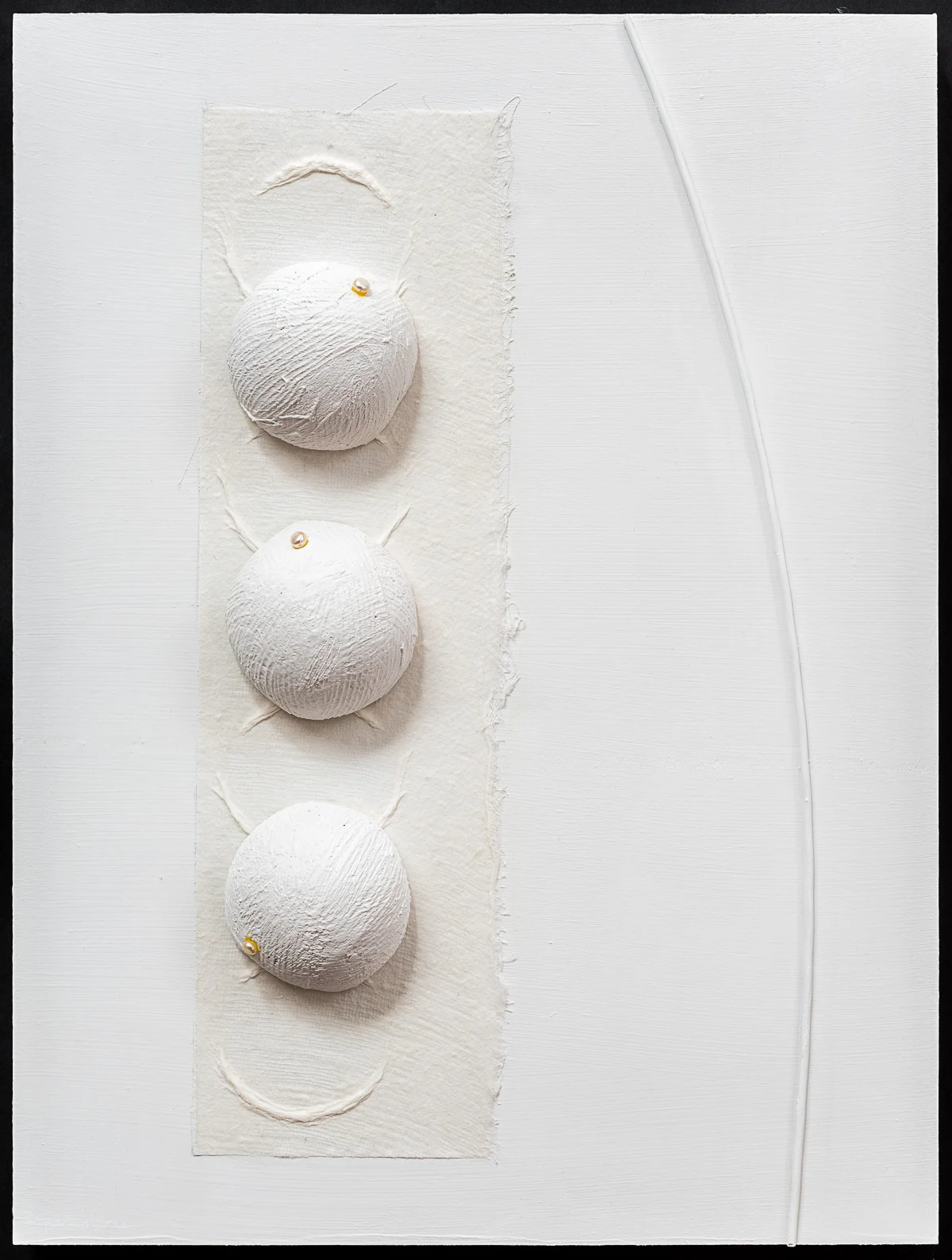
There is a hint of sexuality that overlays the exhibition with objects such as the Phalanx of Phalli, cigars and revolvers bearing testicles and pointing suggestively, even aggressively up at the wedding dress of Femina domestica. Cycladic Nipples, one object from the series called Pantry Ghosts, includes a stack of baby bottle nipples. While leading some to breasts and eroticism, it also implies mothering, sleepless nights.
Cycladic Nipples reveals another layer of meaning. People of the Cyclades, one of the three major ancient Aegean cultures, were known for creating highly stylized, white marble figures of women, their arms folded protectively over their midriffs. Many of the figures are presumed to be pregnant. Are they representative of goddesses or merely, as some archaeologists theorize, dolls? This reveals some of what Andrews Grace asks about how we conceptualize women.
The focus is not solely on women. Andrews Grace offers a series of sculptures entitled Tattered, Torn & Worn. Rat Race features three collars from men’s dress shirts with a subtly-placed image of a rodent placed inside each one. While being a ‘domestic engineer’ is a tedious and difficult role for many women, so is being the primary income earner, a role that men in heterosexual, cis partnerships traditionally have held. For contemporary women the task of washing and ironing said collars still falls to them, as they simultaneously run in their own rat races.
In addition to the references to Cycladic culture, the work echoes other more contemporary artists as well. Andrews Grace cites the Arte Povera movement of Italy whose members created art using domestic materials as influential to her. In particular, Andrews Grace credits Alberto Burri and his use of burlap and gauze as a major source of inspiration.
Thematically, the work stands with artists such as Louise Bourgeois, boldly sculpting the phallus and capturing the monotony of the role of ‘wife’. Some place Andrews Grace in a category with Vancouver’s Gathie Falk and while the theme of the domestic pairs the two together, there is an element of outrageousness, even rudeness present in Andrews Grace’s art that doesn’t appear in Falk’s work.
In many ways older women in our society are invisible. Susan Andrews Grace appears on the surface to play along with that role, while simultaneously thumbing her nose at those who would render her unseen.
Domestic Fetishes Kootenay Gallery, 2020
Video by Carlo Alcos

Domestic Fetishes Grand Forks Art Gallery, Reid Gallery 2026
Video by Jon Worth, Director/Curator